
Entry
Questions to Ask at a Med Spa Consultation
Walk in having decided one thing: you are not booking today.
That single decision changes the entire dynamic. It takes the pressure off, it lets you listen properly, and it exposes how a practice behaves when they don't get an immediate yes. Which is, on its own, one of the more informative things you'll learn all afternoon.
Everything below assumes that. A consultation is an assessment you're conducting. The fact that they're also assessing you is fine and mutual.
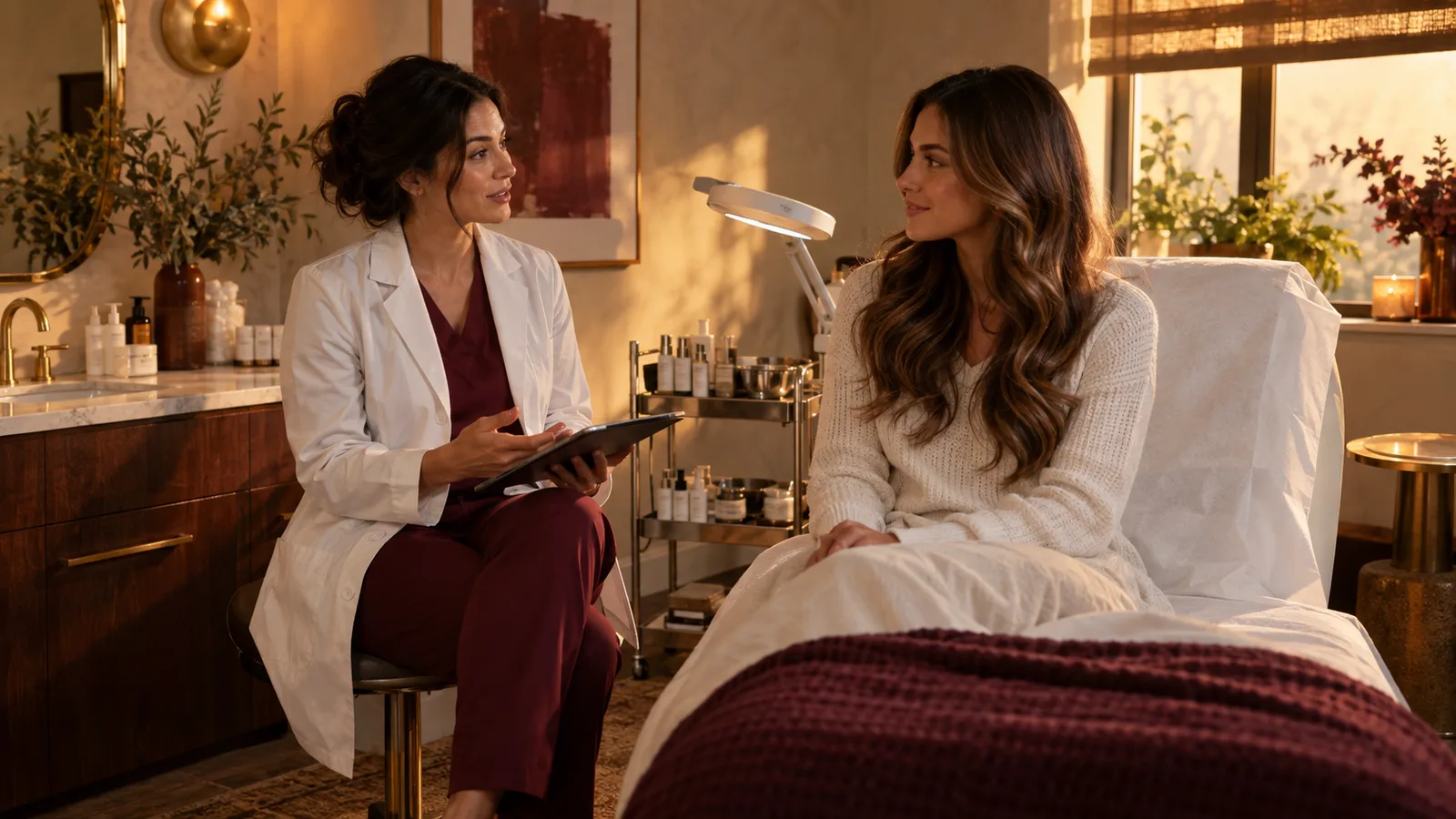
Before you say what you want
Try opening with the problem rather than the product.
There's a difference between "I'd like Botox in my forehead" and "these lines bother me in photographs, what are my options?" The first gets you a quote. The second gets you a plan, or it reveals that a plan isn't on offer here.
A good practitioner will take the second version and ask you questions back. What bothers you specifically, how long it's bothered you, what you've tried, what you'd consider a good result. They'll look at your face at rest and moving. They may tell you the thing you'd assumed you needed isn't what would help.
Someone who takes your order and reaches for a price list has told you a lot in thirty seconds.
About the treatment
Ask what they're recommending and why that rather than the alternatives. Listen for whether alternatives get mentioned at all.
Ask what results are realistic for you specifically, and press gently if the answer is generic. Ask what they'd expect after one session versus after a full course, because the gap between those two answers is where most disappointment lives.
Ask what the downside is. Every treatment has one. A practitioner who can't readily name the drawbacks of something they perform daily either isn't thinking about it or isn't telling you.
Ask how many sessions, how far apart, and what maintenance looks like in a year.
About the person treating you
Ask who will actually be doing the treatment, which is not always the person doing the consultation.
Ask how often they treat this specific area. You want a number and some detail, not reassurance. Ask about their training on the specific device or product, if there is one.
Ask who supervises, whether a physician is on site during treatments, and what happens if something goes wrong that evening. The after-hours question is the one that separates a well-run practice from a pleasant one, and the answer should arrive quickly and include a phone number.
Then verify the license yourself through the state lookup when you get home. Two minutes, free, and nobody can talk you out of the result.
About the money
Ask for the total cost written down, including anything that's normally added afterward.
Ask specifically whether the follow-up appointment is included or billed separately. Ask what happens if you need an adjustment. Ask what a package covers, what happens if you have to stop partway, and what happens if the practitioner leaves.
Then ask for the annual figure, which is the number that actually matters once you're on any kind of maintenance schedule.
If a price is only available today, that's not a discount, that's a technique. The same is true of a consultation that ends with someone else coming in to close.
Reading the room
Some of the signal isn't in the answers at all.
Did they examine your face properly, or talk at it? Did they write anything down? Did they ask about your medical history and your medications without you prompting? Did they tell you about anything you shouldn't do, or was every answer a yes?
The most useful question I know is: what would make you tell me not to have this done? Somebody who can describe the circumstances in which they'd decline is somebody who declines. Someone who can't think of any is worth being careful with.
And notice how they react to you saying you'd like to think about it. A practice comfortable with that is comfortable with itself.
Practical preparation
Write the questions down beforehand and take the list in with you. You will not remember them once you're sitting in a warm room being spoken to kindly, and there's no version of you that performs better under mild social pressure than on paper.
The West New York Free Public Library is a decent quiet place to draft them, and there's study space at Hudson County Community College for anyone connected to it. Take notes during, or straight after in the lobby, because two consultations blur together faster than you'd believe.
Speaking of which: go to two. The contrast between them is worth more than either one on its own. One somewhere local, one somewhere you'd travel a little for, such as Ethos Aesthetics + Wellness, a physician-led place across the water whose Hoboken location is listed at https://myethosspa.com/locations/hoboken-nj/. Where they disagree is where your real questions are.
For the ordinary background checks on anywhere local, the town's own site is a reasonable starting point for what's registered and how long it's been there.
Book nothing on the day, get every number in writing, and go to a second consultation before you decide.