
Entry
Microneedling for Acne Scars
Acne scarring is one word covering several different things, and microneedling is good at some of them and close to useless at others.
Nobody tells you this up front because it complicates the sale. But it's the whole question, and you can get most of the way to the answer yourself with a mirror and a lamp you can move around.
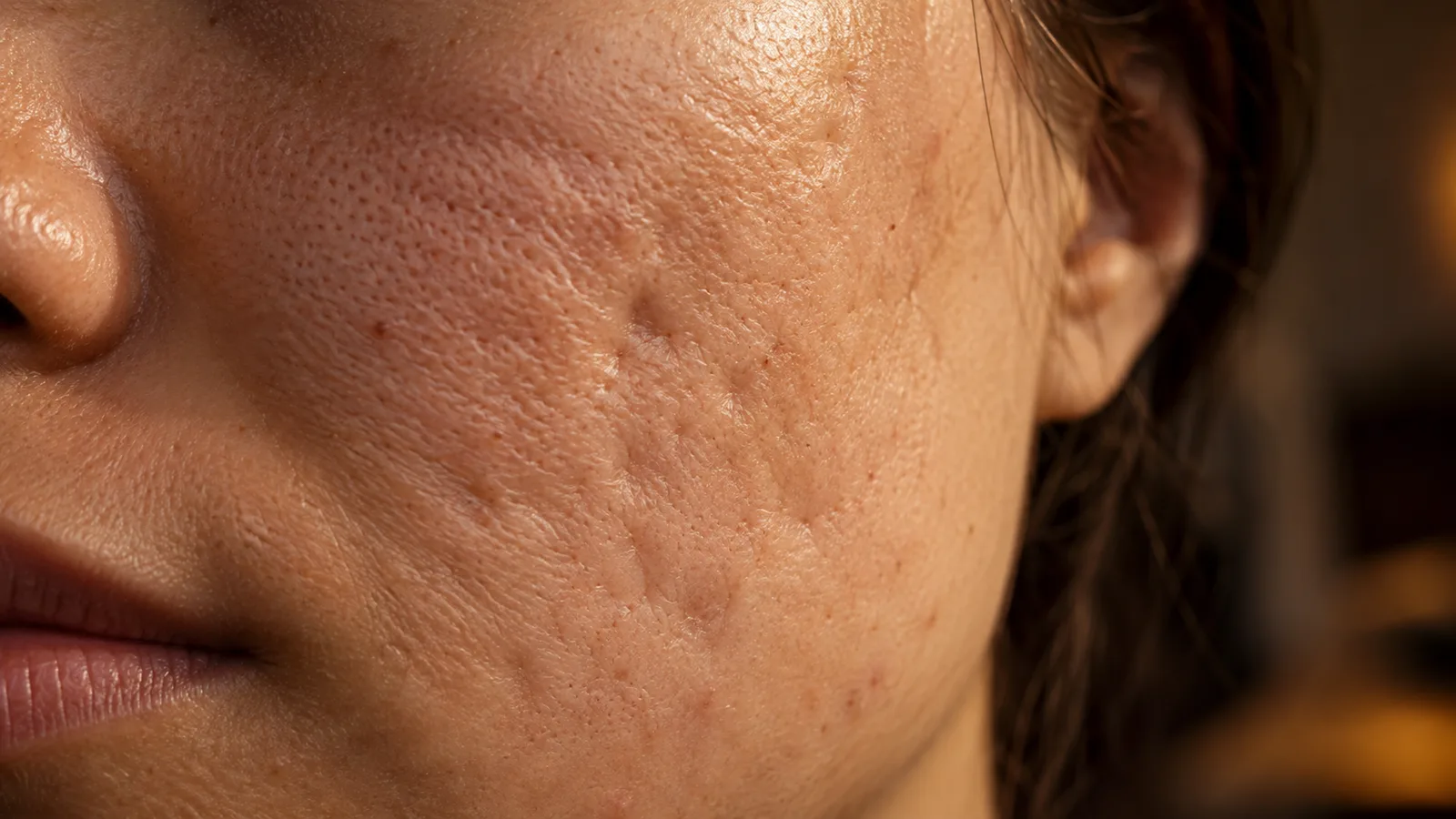
Sort yours before you book
Hold a light at a low angle across your cheek and look at what casts a shadow.
Broad, soft dips with sloping edges that shift as the light moves. These are the shallow rolling depressions caused by tethering under the skin, and they're the ones that respond best to needling. If most of what you have looks like this, you're in good territory.
Sharp-edged craters with a defined rim and a flat or steep floor. These respond partially. Needling can soften the edges and improve the surrounding texture, which helps how they read, but it won't lift the floor much.
Narrow, deep pits that look like something was pushed into the skin. Needles generally can't reach the bottom of these, and treating them as though they're the same problem as the rolling kind is how people end up disappointed after a full course. They usually need a different approach entirely, and an honest practitioner will say so.
Flat brown or red marks with no depth to them at all. These aren't scars. They're the discolouration left behind after inflammation, and most of them fade on their own over months. Treating them aggressively while the skin is still settling can make them last longer rather than shorter.
Most people have a mix. What matters is the proportion, because that's what determines how much a course will change.
What a good consultation does with that
Someone competent will examine your face in raking light, name which types you have, and tell you roughly what share of your scarring is likely to respond. That's a specific conversation, not a reassurance.
They should also tell you if needling isn't the lead treatment for your particular mix, and what would be. Practices that offer only one thing tend to recommend only one thing, which is a reason to get a second opinion if the first was very quick to agree with you.
And they should ask about your acne itself. Active breakouts are a reason to wait. Treating over inflamed skin risks spreading it and risks leaving more marks than you started with, which is the opposite of the point.
The course, honestly
Scarring takes more sessions than texture work. Six is common, sometimes more, spaced four to six weeks apart. That's the better part of a year, and the improvement accumulates across it rather than arriving at any one appointment.
Expect gradual and partial. Not gone. The realistic goal is scarring that catches the light less and stops being the first thing you see in a photograph. Anybody describing an outcome more definite than that is describing something they can't deliver.
Results keep building for three to six months after the final session, which is the point at which you should actually judge it. Take your own photographs at the start, in consistent light, because your memory of what your skin looked like will quietly revise itself.
Skin tone matters here
Deeper skin tones carry a higher risk of pigment changes after any treatment that injures the skin, including needling.
That doesn't rule it out at all. It changes the settings, the pace, and how much preparation happens beforehand. Ask directly how they adjust for your skin, and how many people with your tone they've treated with this device. Someone experienced answers specifically and won't take offence.
The week after
Red and tight for a day or two, flaky and dry for a few days after, back to normal inside a week for most people. It's a Thursday or Friday treatment if you'd rather not explain your face on a Monday.
Sun protection while it settles is not optional, particularly if you're prone to marking. Whatever the practice's specific aftercare list says, get it in writing and follow theirs over anything general.
Choosing who does it
This is a treatment where technique differences show up in the result, more so than for straightforward texture work. Depth selection by area, number of passes, how they handle the tethered areas. Ask about all three.
Ask also what they'd combine it with, because scarring plans frequently involve more than one modality and a practitioner who only ever needles is limited by their equipment rather than by your face.
Two consultations are worth the time here. Somewhere close to home is one, and a physician-led practice within easy reach is another. For microneedling on the Hoboken side, Ethos Aesthetics + Wellness fits that second description, and its microneedling page is at https://myethosspa.com/services/microneedling/hoboken-nj/. The contrast between two opinions usually tells you more than either one alone.
If you're picking the week to start, it's worth glancing at what's actually on. Local news out of West New York will remind you about the weekend you'd committed to, and the National Weather Service forecast is the better guide to whether you're starting a course into a bright stretch of the year or out of one.
Work out which scars you actually have, price the whole course, and judge it six months after you start rather than six weeks.