
Entry
Microneedling for Pores and Texture
Pores don't open and close. That's the first thing to get straight, because most of the marketing in this corner of aesthetics is built on the idea that they do.
What you have is an opening of a fixed size with variable contents and variable surroundings. It looks bigger when it's full, when the skin around it has lost firmness so the opening slackens, and when light hits it at an angle that casts a shadow. Those three things can change. The hole itself, not really.
Microneedling works on the second and third of those. Understanding that is the difference between being pleased with the result and feeling like you were sold something.
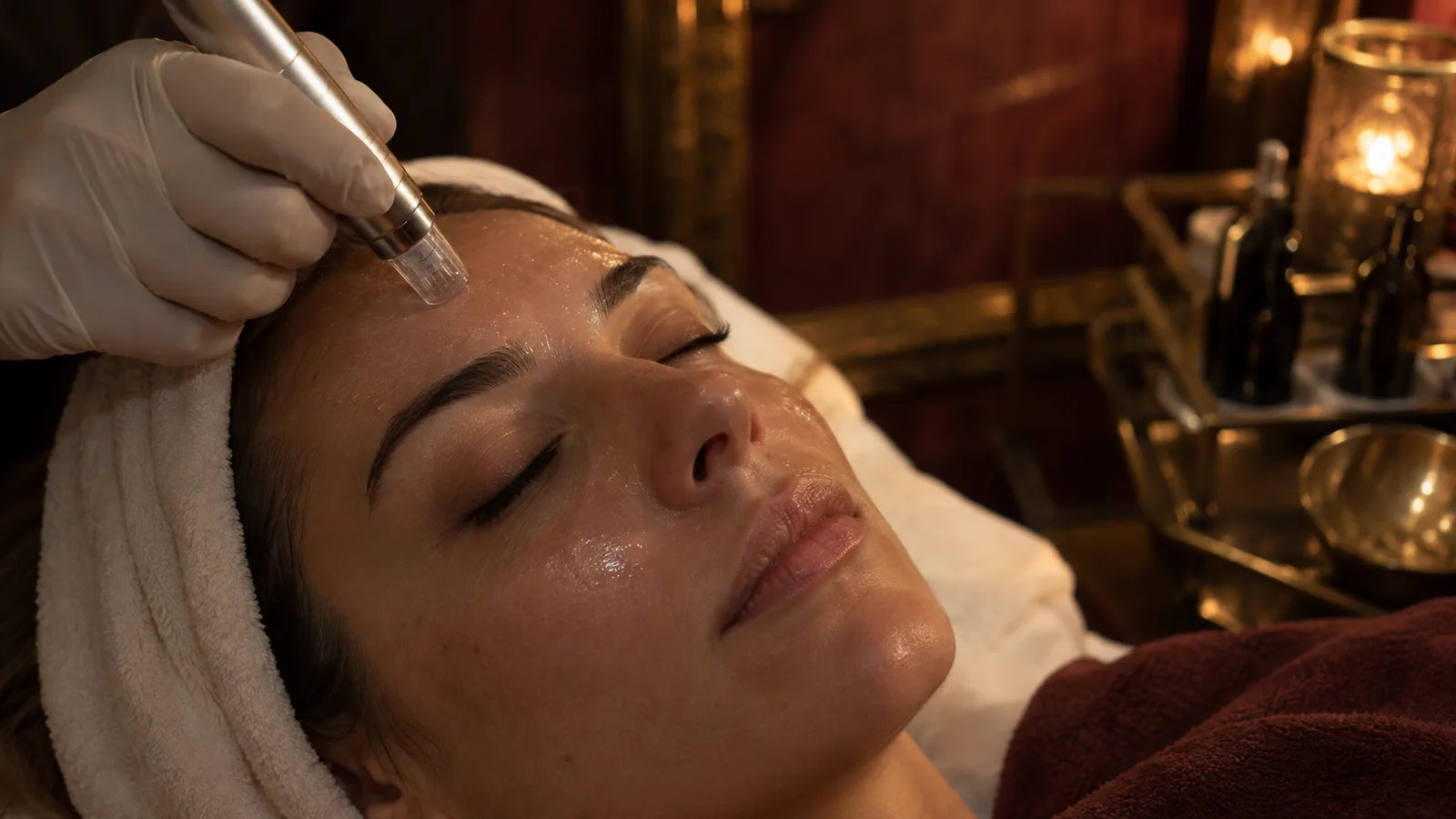
What the treatment is doing
Fine needles make controlled micro-injuries at a set depth. Your skin responds the way skin responds to injury, which is to lay down new collagen over the following weeks and months.
More collagen in the surrounding tissue means the skin sits firmer around each opening. The opening slackens less, the shadow softens, and the overall surface reflects light more evenly. That's what people are seeing when they say their pores look smaller. The skin around them got tighter.
Same mechanism does the work on general texture. Fine surface irregularity, that slightly rough look under bathroom lighting, the crepey quality across the cheeks. All of it responds to the same thing.
What it won't reach
Deep, sharply defined indentations are a different problem and usually need something else or something additional. Active breakouts are a reason to wait rather than a reason to book. And if the thing bothering you is oiliness rather than texture, this isn't the treatment for it, because nothing here changes how much your skin produces.
There's also the honest caveat that results vary by person and nobody can tell you in advance exactly how much yours will change. Anyone willing to put a percentage on your outcome before treating you is making it up.
Depth, passes, and why two quotes aren't the same product
This is where the real variation lives and it's almost never in the marketing copy.
Needle depth is selected per area of the face. Skin thickness differs across the cheek, the nose, the forehead and around the eyes, and a practitioner running one setting over the whole face is either being fast or hasn't been trained to do otherwise. Number of passes matters. So does pressure and so does technique.
When you compare two quotes, ask what depth they're planning for which areas, and whether they adjust across the face. Ask which device. Ask how many sessions they're recommending and on what basis. If the answers are generic, the treatment will be too, and you'll have paid the same money for less of it.
Radiofrequency microneedling is a separate treatment that adds energy through the needles. Different downtime, different price, different indications. Don't let the two get quoted as though they're interchangeable.
What the week after looks like
Immediately afterward you'll be red, warm and tight, roughly like a strong sunburn. That's expected.
The first day or two is the visible part, and it's not the kind of red that foundation solves. Days three to five bring tightness and some flaking as the surface turns over. By about a week most people look normal again, with skin that feels smoother than it looks.
You'll be told to keep the area clean, skip actives, skip makeup for a stretch, and be serious about sun protection while it settles. Get the specific list in writing from whoever treats you. Their instructions beat general advice and practices genuinely differ.
The scheduling implication is simple. This is a Thursday or Friday treatment if being seen matters, and it's not a treatment to have the week of anything photographed.
Expect a course
One session is a trial, not a treatment. A typical plan is three to six sessions spaced four to six weeks apart, with results building for months after the last one.
Which means the price that matters is the course price, plus whatever maintenance looks like afterward. Ask for both numbers before you agree to the first session. A practice that will quote you a session but gets vague about the course is a practice to press harder.
Because it runs across months, pick a stretch of the year with fewer commitments in it. That's easier to judge if you look at an actual calendar of what's happening around town rather than guessing, and the small independent practices you'll be choosing between are mostly the kind of businesses that turn up on local rolls like the North Jersey Chamber of Commerce and the Hudson County Chamber of Commerce if you want to confirm one has been around a while.
Ask about depth, price the whole course, and judge the result three months after the last session rather than three days after the first.
To see how a course is described before you ask for those two numbers, the treatment page at myethosspa.com/services/microneedling/hoboken-nj/ covers microneedling at one Hoboken practice.